
Why Your Best Employees Are Staying Silent (And What It’s Costing You)
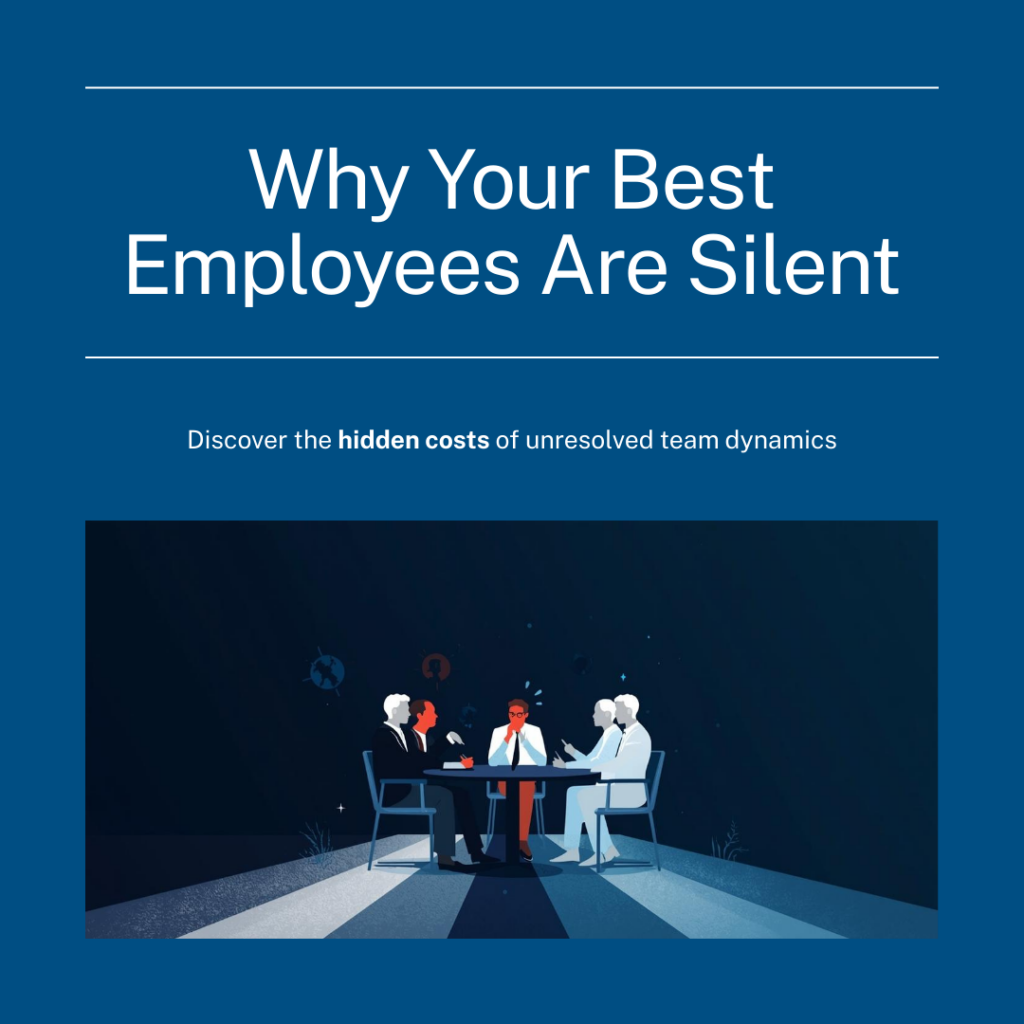
Think about your last leadership team meeting. Every item got reviewed. People nodded. Nobody pushed back. The meeting ended on time, and everyone walked out. Then, about ten minutes later, two of your best people found each other in the hallway and had the real conversation—the one that should have happened in the room.
That gap—between what gets said in the meeting and what gets said outside of it—is one of the most expensive problems in a growing business. Patrick Lencioni called it artificial harmony. And in his landmark work The Five Dysfunctions of a Team, he argued that the absence of conflict is not a sign of a healthy team. It is a sign of a broken one.
For business owners running $5M to $50M companies, this shows up in subtle but costly ways. Decisions get made in rooms but reversed in hallways. Good ideas die because no one felt safe enough to challenge the status quo. Your most capable people disengage quietly, long before they ever hand you a resignation letter.
What Lencioni Actually Said (And Why It Still Matters in 2026)
Lencioni’s five dysfunctions build on each other like a pyramid. At the base is absence of trust—the unwillingness to be vulnerable with each other. On top of that sits fear of conflict. And fear of conflict creates exactly what you see in most leadership meetings: polished agreement that masks real disagreement.
Here is the key insight that most leaders miss. Lencioni was not saying that teams should fight. He was saying that teams should be willing to engage in what he called “passionate, unfiltered debate around issues of importance.” That is a very different thing from arguments and blame. It is the kind of productive tension that actually leads to better decisions.
The problem is that most leaders, especially founders and longtime CEOs, have accidentally trained their teams not to push back. Maybe they got defensive when challenged once. Maybe they moved quickly past ideas that contradicted their own. Maybe the culture of the company simply rewards agreement and punishes dissent. Whatever the cause, the result is the same: silence.
The Real Cost of Playing Nice
Let’s be specific about what artificial harmony actually costs a $15M or $25M company. First, you get poor decisions. When nobody challenges the strategy in the room, you lose the chance to catch blind spots before they become expensive mistakes. The leader’s perspective, however experienced, is still just one perspective.
Second, you get disengagement. Research from Gallup consistently shows that employees who feel their voice does not matter are significantly more likely to be disengaged. In a company with 50 to 150 employees, low engagement is not an HR problem. It is a revenue and retention problem. Your best people have options. They will find a culture where their voice counts.
Third, and perhaps most damaging: you lose institutional intelligence. The people closest to your customers, your operations, and your front lines have information you do not have. When they stop sharing it—because experience has taught them that sharing leads to awkward silence or dismissal—you are making decisions with incomplete data. This connects directly to how we think about leadership effectiveness at Newlogiq: the leader who creates safety for honest input consistently outperforms the one who demands agreement.
How to Tell If Your Team Has Stopped Talking
Most leaders with artificial harmony problems do not know they have them. That is part of what makes it so insidious. Here are the signs I look for when working with a new client.
Meetings end too quickly. If every agenda item gets resolved in under ten minutes and there are never any hard conversations, that is not efficiency. That is avoidance. Real decisions in complex businesses take real debate.
Agreement comes too fast. If your team consistently aligns on the first option presented, you should be suspicious. Good teams generate real alternatives and push on assumptions before committing. When consensus happens in under five minutes, someone is staying quiet.
Conversations happen after the meeting. As I mentioned at the top, the hallway conversation is the red flag. If you are the last person to know that your team has reservations about a decision you made, you have an artificial harmony problem.
Feedback stays surface level. Annual reviews that produce only positive feedback—or that produce carefully cushioned criticism delivered in vague language—are a symptom of this same culture. Real growth requires honest feedback. As we explore in our work on developing your leadership team, psychological safety is not the absence of standards. It is the presence of trust.
What Lencioni Recommends (And What Actually Works)
Lencioni recommends that leaders become “miners of conflict.” That means actively pulling buried disagreements to the surface. It means asking questions like: “Who disagrees with this?” or “What are the strongest arguments against this approach?” It means rewarding the person who raises the hard question, not tolerating them.
I have used a simple practice with clients that I call the “Contrarian Round.” Before any significant decision gets finalized, one team member is assigned the role of making the strongest possible case against it. Not because we expect the decision to change, but because the exercise surfaces assumptions, risks, and objections that would otherwise stay buried. After a few rounds, you will find that your quieter team members start to participate more naturally. They see that challenge is not just allowed—it is expected.
Marshall Goldsmith’s coaching work adds another layer here. He has written extensively about how leaders inadvertently discourage input by adding their own opinion too early, by “winnersizing” (agreeing and improving upon) every idea, or by reacting defensively to pushback. The leader sets the tone. If you want your team to speak up, you have to model what it looks like to welcome disagreement.
Building a Culture Where People Actually Speak Up
Culture change in a $10M to $30M company is not a programs initiative. It is a behavioral change that starts at the top and happens repeatedly, in small moments, over time. Here’s the practical framework I recommend. You can also see how this ties into your overall growth strategy and team alignment.
Make it safe to be wrong.
The next time someone raises an idea that does not work, your response is the teaching moment. If you dismiss it quickly, you train everyone else in the room to stay quiet. If you engage it seriously—even while ultimately declining it—you signal that ideas are welcome.
Ask for disagreement explicitly.
Do not just open the floor. Ask specifically: “Who sees this differently?” or “What am I missing here?” The explicit invitation lowers the social risk of being the person who pushes back.
Follow up on what gets raised.
When someone raises a concern or a challenge, come back to it. Even if the decision did not change, acknowledge what was raised: “Jen raised a concern in our last meeting about the timeline. Here’s how we addressed it.” This signals that speaking up leads to real engagement, not just acknowledgment and dismissal.
Build it into your meeting cadence.
Using the EOS (Entrepreneurial Operating System) model, Issues Lists exist for exactly this purpose—to surface and resolve the real problems that are slowing the business down. When conflict has a sanctioned, structured place in your operating rhythm, it becomes normal. Normal conflict is healthy. Suppressed conflict is poison.
The Leader’s Real Job
Here is the hardest truth Lencioni offers: if your team is not engaging in honest conflict, that is a leadership problem. Not a team problem. Not a personality problem. A leadership problem.
The culture of your company is a direct reflection of what you tolerate, what you model, and what you reward. If you have been tolerating polite agreement while decisions fester and resentments build, the fix is not a team training. The fix is you deciding to do something different.
The good news is that this is entirely fixable. Teams that learn to disagree well become dramatically better at deciding, executing, and holding each other accountable. That is not a coincidence. It is exactly the model Lencioni mapped out twenty-five years ago—and it still holds.
If you want to explore what this looks like in practice for your leadership team, browse the Newlogiq blog or reach out directly. The conversation your team is not having might be the most important one you can start.
Sources & Further Reading
Lencioni, Patrick M. The Five Dysfunctions of a Team (20th Anniversary Edition). Jossey-Bass.
Consult Clarity: 13 Warning Signs of Artificial Harmony in Your Team